As the IDIA project officially launches, Action Lab for Development sets out to put ordinary citizens at the heart of Cameroon’s artificial intelligence future
DOUALA — It began, as many important things do, with a simple conviction: that the future of artificial intelligence in Cameroon should not be decided for its people, but with them.
This week, that conviction takes a decisive step forward. The Initiative for the Development of Artificial Intelligence (IDIA), led by Action Lab for Development (ACTLAB) in partnership with the pan-African advocacy organisation Niyel, has officially moved from planning into action. With the project agreement now signed and the first phase of implementation underway, one of the country’s most ambitious efforts to democratise the conversation around AI is ready to begin.
The India Project brings together the Artificial Intelligence for Development (AI4D) programme, Canada’s International Development Research Centre (IDRC), UK International Development, Niyel, Action Lab for Development (ACTLAB), and national implementing project partners to advance responsible, inclusive, rights-based and sustainable AI for development.

To mark the launch, ACTLAB’s Cameroon National Coordinator, Mme Budi Laura Yenec, has convened the project’s kick-off planning meeting for Sunday, 6 September 2026, at 4:00 PM (GMT+1), at the Metropolitan Hotel, Terminus St Michel, Douala — a moment for the team to align, organise, and begin rolling out activities across the country.
“One step at a time, with creativity,structure and purpose, we are turning the IDIA vision into something real,” says Tawong Cornelius, founder of Action Lab for Development. “This is about making sure that as AI reshapes our world, no community in Cameroon is left behind.”

Tawong Cornelius, Founder and CEO Action Lab for Development
A Pivotal Moment for Cameroon
The timing could hardly be more significant.
In July 2025, Cameroon launched its first-ever National Artificial Intelligence Strategy (SNIA) under the Ministry of Posts and Telecommunications (MINPOSTEL), setting the bold ambition of positioning the country as a leading African AI hub by 2040. The strategy spans AI governance, digital sovereignty, data infrastructure, innovation, education, multilingual AI systems, and international cooperation.
Yet as the technology advances, real challenges remain — digital divides, the high cost of internet access, and unequal opportunity between those who are connected and those who are not. Without deliberate effort, AI risks widening the very gaps it could help close.
This is precisely the gap IDIA sets out to bridge: ensuring that AI governance in Cameroon is not only advanced and innovative, but ethical, inclusive, and rooted in the realities of everyday citizens.
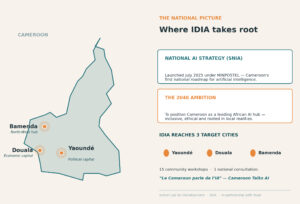
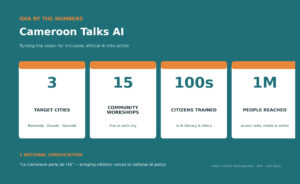
IDIA in Cameroon: 15 community workshops across Bamenda, Douala, and Yaoundé, leading to the national consultation, “Le Cameroun parle de l’IA” — Cameroon Talks AI.
What Is IDIA?
At its heart, IDIA is about participation.
The project’s central goal is to guarantee that communities across Cameroon can take part — meaningfully and knowledgeably — in the discussions and decisions shaping AI policy and regulation. It rests on three pillars: engaging communities to understand AI and voice their expectations and concerns; creating a platform for dialogue between civil society, decision-makers, experts, and communities; and co-building recommendations that reflect citizens’ real needs to guide national policy and investment.
In short, IDIA aims to make sure that when Cameroon talks about artificial intelligence, everyone has a seat at the table — especially women, youth, rural communities, persons with disabilities, and groups too often left out of the conversation.
What Is ACTLAB’s Role in IDIA?
If IDIA is the vision, Action Lab for Development is the engine driving it.
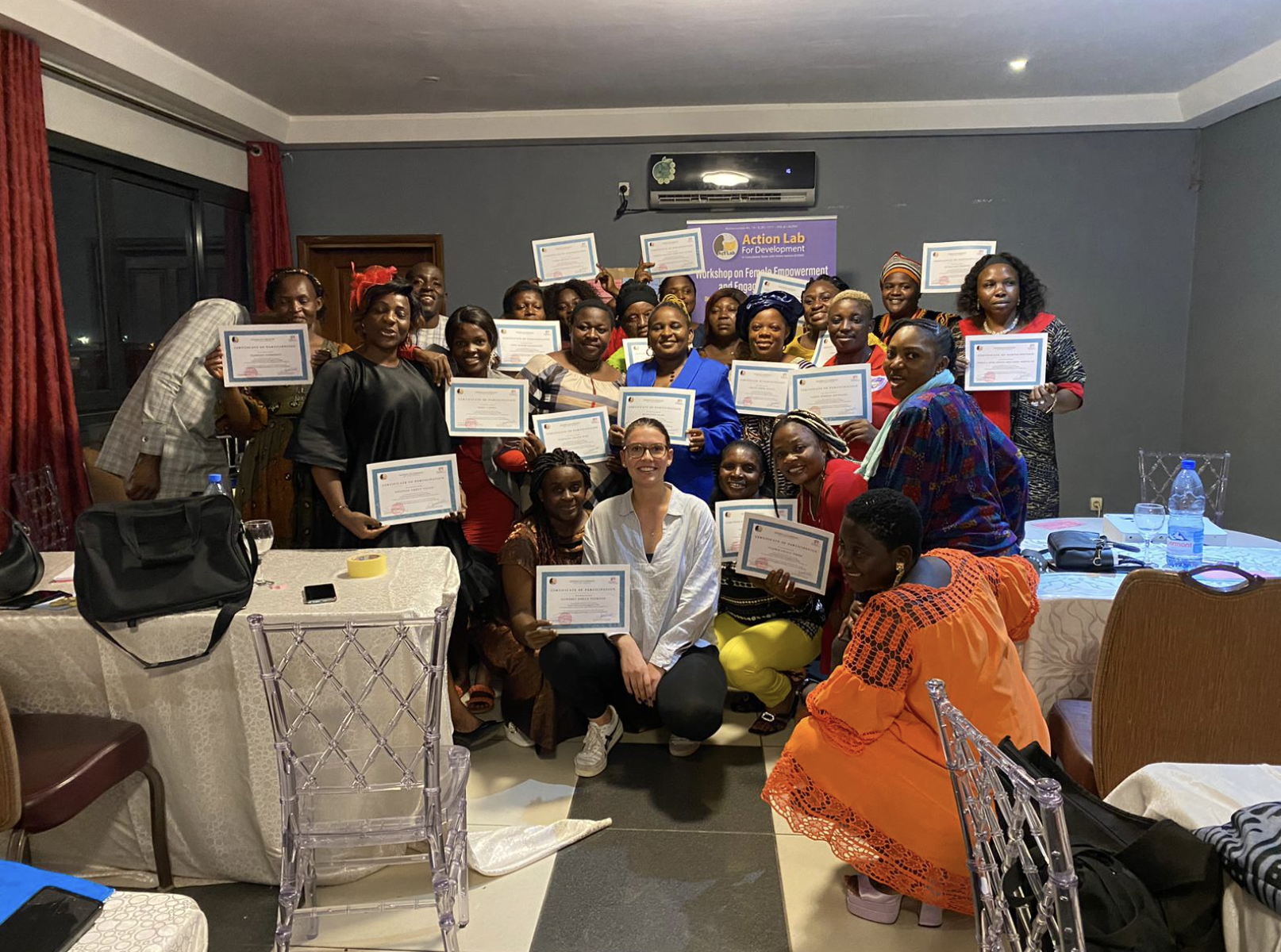
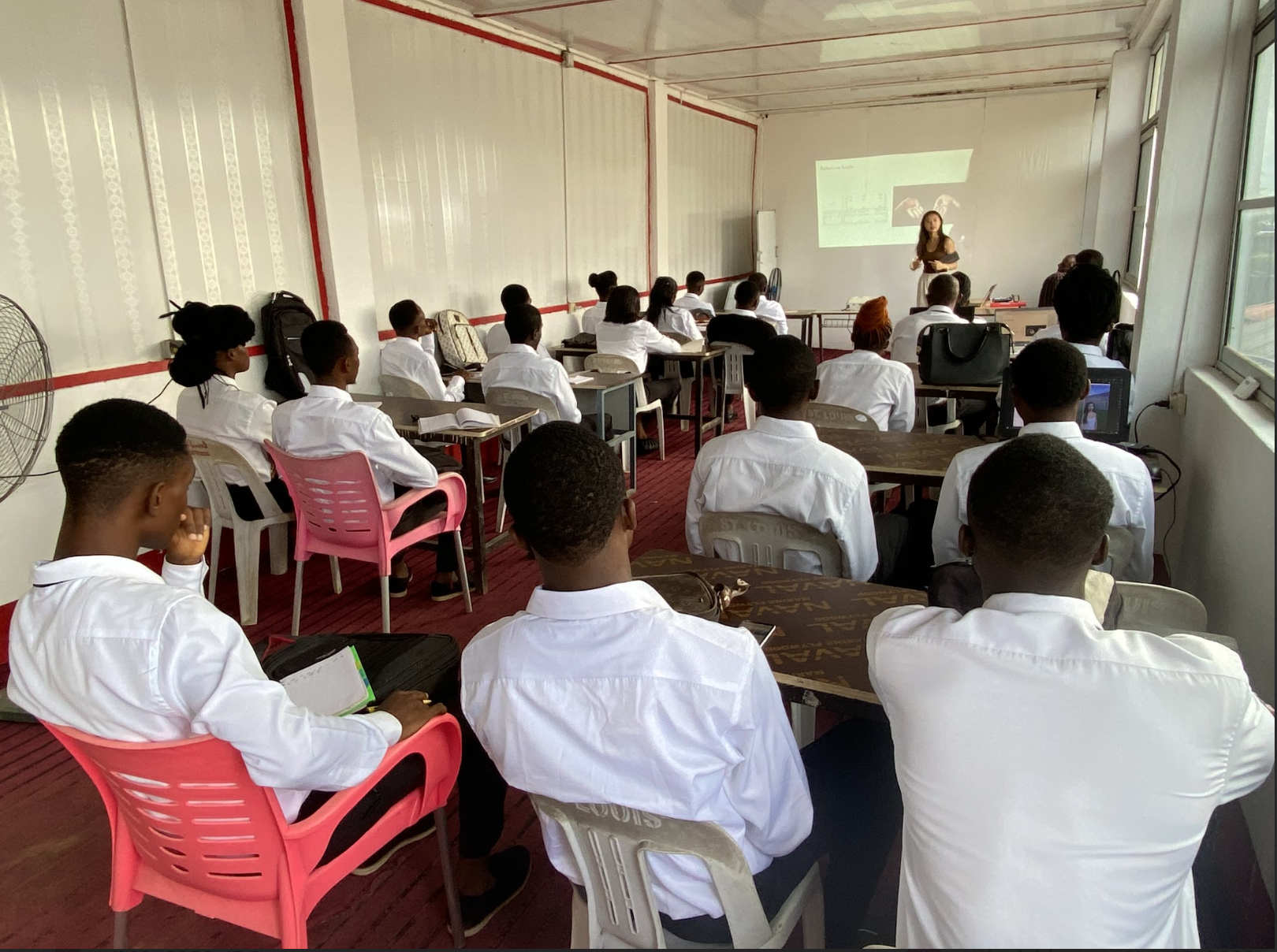
As the lead implementing organisation, ACTLAB is responsible for turning the initiative from plan into action on the ground. That means designing and running the community workshops in Bamenda, Douala, and Yaoundé; delivering the training in AI literacy, ethics, and practical tools; and convening the national consultation that will carry citizens’ voices to decision-makers.
ACTLAB brings three things to the table that make it well suited to this role. First, experience: as a non-profit founded in 2016, registered in Cameroon and holder of UN ECOSOC Special Consultative Status since 2020, it has years of work in civic engagement, policy dialogue, and capacity building. Second, local roots: with teams embedded in Cameroon’s communities, it can reach the very citizens — women, youth, rural populations, and marginalised groups — that top-down approaches so often miss. Third, and perhaps most distinctively, its own homegrown tool for ethical technology: MoralityCode AI, the platform ACTLAB created to help people reason through the ethical questions AI raises, which sits at the heart of the project’s training.
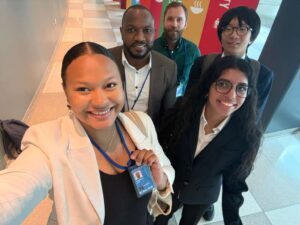
ACTLAB at the UN High-Level Political Forum (HLPF) 2026 — carrying the voice of inclusive, ethical development from Cameroon to the global stage.
Working hand in hand with its partner Niyel and a wide coalition of stakeholders, ACTLAB’s role is ultimately that of a bridge — connecting policy to people, and ensuring that Cameroon’s AI future is shaped not only in ministries and boardrooms, but in classrooms, community halls, and on the airwaves across the country.
From the Grassroots to the National Stage
The initiative unfolds in two connected phases.
The first is a season of community engagement and mobilisation. Between now and December, ACTLAB will run a series of five workshops in each of three major cities — Bamenda, Douala, and Yaoundé — building understanding step by step:
- AI literacy and the National AI Strategy, introducing key concepts and Cameroon’s priorities across education, health, agriculture, entrepreneurship, and public services.
- Ethical AI, digital rights, and responsible governance, drawing on human-rights principles and African ethical perspectives such as Ubuntu, and on the ethical-reasoning modules of ACTLAB’s own MoralityCode AI platform.
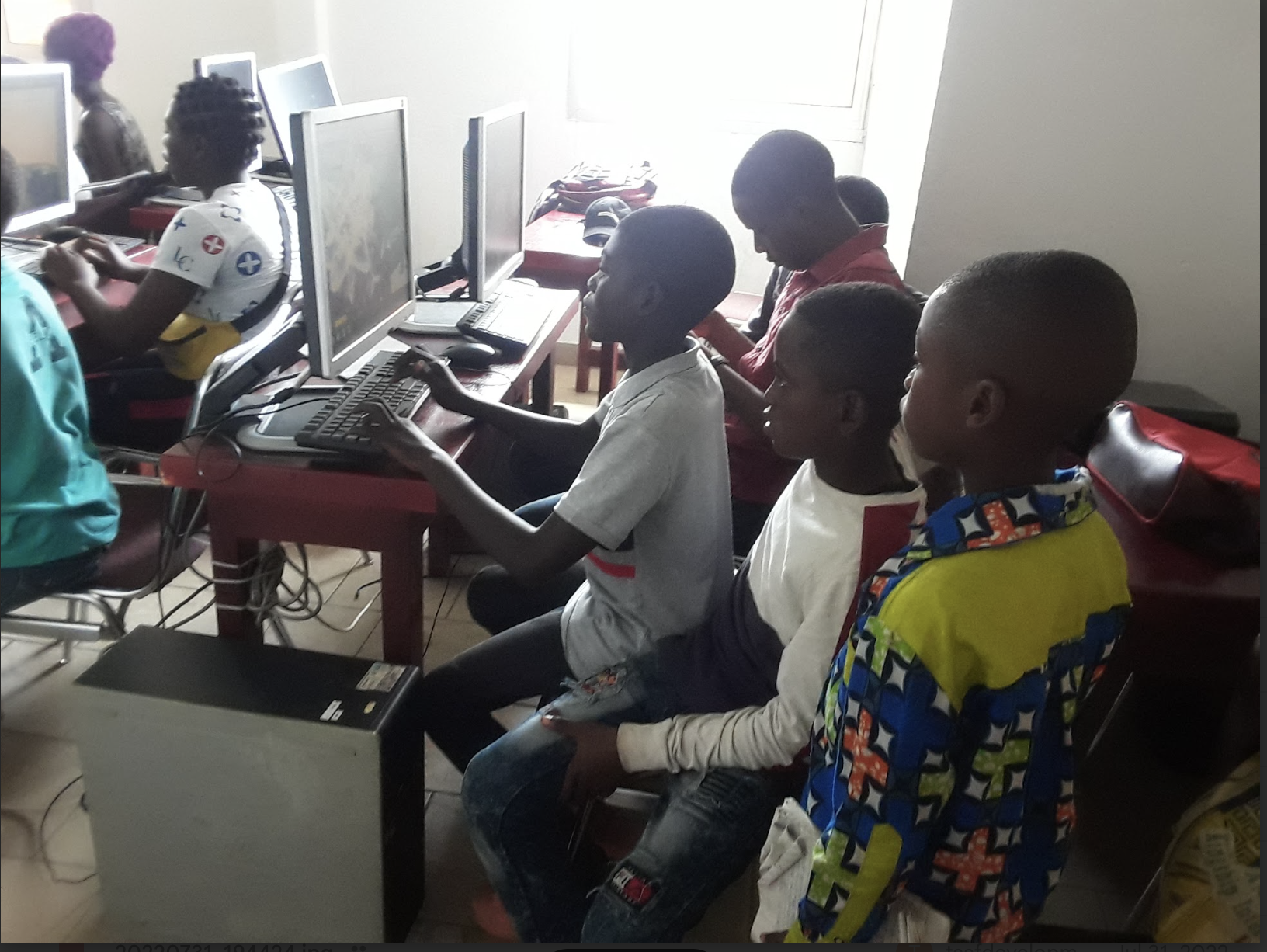
- Practical AI skills, with hands-on training in tools such as ChatGPT, Gemini and MoralityCode AI, so participants gain real, responsible experience.
- Co-creation of community recommendations, where citizens’ priorities are shaped into concrete proposals.
- Preparation for the national consultation, equipping community representatives to carry their voices forward.
Alongside the in-person workshops, the project will reach far wider through online webinars, digital mobilisation on WhatsApp and Facebook, and a series of thematic radio and community-media programmes — including sessions dedicated to AI and inclusion for women, youth, and marginalised communities.
The second phase brings it all together in a national consultation with a name that captures its spirit: “Le Cameroun parle de l’IA” — Cameroon Talks AI. Here, representatives drawn from the community workshops will join ministries, universities, the private sector, researchers, and development partners to co-create national recommendations on AI governance — and to produce a consultation report and a reproducible model that other organisations across Cameroon can adopt.
An Ambition Measured in People
The scale of the ambition is striking. Over the course of the project, ACTLAB aims to mobilise dozens of civil-society organisations, train hundreds of citizens in AI literacy and ethics, gather at least a hundred community contributions, and reach — through radio, nationall media, and digital platforms — as many as a million Cameroonians with awareness of AI, its opportunities, and its risks.
Behind every one of those numbers is a person: a young student in Bamenda discovering what AI could mean for their career, a woman entrepreneur in Douala learning to use new tools with confidence, a community leader in Yaoundé helping to shape the rules that will govern this technology for years to come.
A Partnership Built on Purpose
IDIA is very much a collective effort. ACTLAB — a non-profit founded in 2016, registered in Cameroon, holder of UN ECOSOC Special Consultative Status since 2020, and internationally incorporated in Canada — brings its experience in civic engagement, policy dialogue, and capacity building. Niyel contributes its expertise in advocacy and monitoring across Africa.
The project also reaches out to a broad coalition of partners, from government ministries — including MINPOSTEL, MINESUP, MINESEC, MINEFOP and MINPMEESA — to the University of Yaoundé I and the University of Douala, community radio stations, national digital media, youth and women’s organisations, disability-rights groups, and digital-innovation networks.
Together, they share a single conviction: that technology should serve humanity, and that the wisest way to build Cameroon’s AI future is to build it inclusively.
The Road Ahead
As the team gathers in Douala this weekend, IDIA stands at the threshold between promise and practice. The signatures are in place. The plan is set. The work begins.
For ACTLAB, the milestone is not the contract or the launch. It is what they represent — the start of a national conversation in which every voice can be heard, and a shared effort to ensure that as artificial intelligence transforms Cameroon, it does so with fairness, dignity, and inclusion at its core.
Because the future of AI in Cameroon will not be written by machines. It will be written by Cameroonians — together.
Action Lab for Development (ACTLAB) is a non-profit organisation promoting education, entrepreneurship, innovation, advocacy, and sustainable development. To learn more about IDIA, MoralityCode AI, and how to get involved, visit www.actlabs4dev.org or follow ACTLAB on LinkedIn, Facebook, Instagram, and X.
‘