Every year, International Women’s Day invites us to reflect on progress.
Over the past decade, the global conversation around women’s education, gender equality and women’s rights has become increasingly important. More girls are enrolled in school than ever before, women are increasingly visible in leadership, innovation and entrepreneurship, and global initiatives have helped place women’s empowerment at the center of development agendas.
Yet progress isn’t spelled as equality.
Across the world, opportunities are still shaped by gender. According to UNESCO (2024), over 120 million girls worldwide remain out of school often due to poverty, cultural barriers, early marriage or a word that’s occupying a place in today’s conversations: *conflict*.
In many regions, women continue to face structural challenges in accessing education, financial resources and leadership opportunities regardless of their talent or ambition.
Using International Women’s Day as a moment of reflection, from Action Lab For Development we decided to ask ourselves a question: _What happens when we educate a woman?_
The answer goes far beyond the classroom.
Educating women is one of the most powerful investments a society can make.
Research from the World Bank (2011) consistently shows that every additional year of schooling for girls can increase their future earnings by up to 20 percent. But the impact of education extends far beyond economic outcomes.
When women are educated, families become healthier, communities become more resilient and economies become more innovative.
Educated women are also more likely to participate in civic life, advocate for their rights and contribute to policy discussions that affect their communities so their voices help challenge long-standing norms that have historically been limiting women’s opportunities.
This transformation reaches social and cultural dimensions as well.
As a matter of fact, studies show that children of educated mothers are twice as likely to attend school, creating a ripple effect that strengthens entire generations.
As you can see, it allows women not only to participate in society but to shape it. Education, therefore, does not erase culture, it can be a powerful tool that empowers women to shape it.
The impact of women’s education becomes even more visible when we look at entrepreneurship, technology and innovation.
Women entrepreneurs are among the fastest-growing drivers of economic development worldwide. According to the Global Entrepreneurship Monitor (2025), millions of women are launching businesses that create jobs, support families and strengthen local economies. The same happens in technology and Artificial Intelligence: women’s contributions are equally vital thanks to them bringing new approaches to leadership, problem-solving and creativity. Their ideas influence fields ranging from education and public health to digital innovation and sustainable development redefining what progress looks like.
The benefits of educating women don’t belong only to women.
They belong to entire societies.
Countries that prioritize gender equality in education often experience stronger economic growth, improved social stability and greater resilience in times of crisis than those countries who don’t.
Simply put: when women move forward, societies move forward with them.
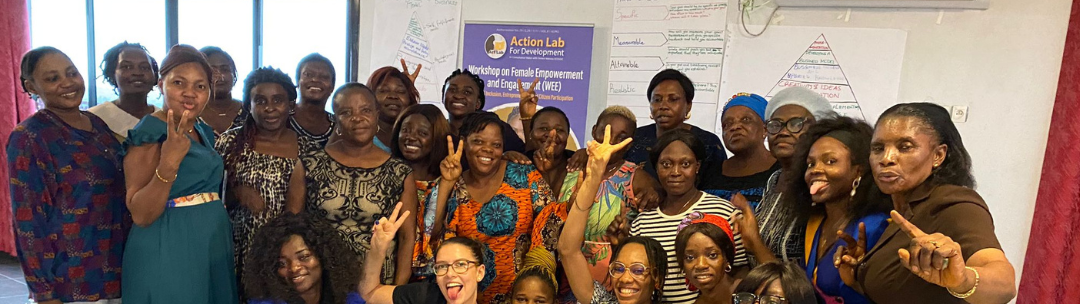
At Action Lab for Development, empowering women isn’t just an aspiration, it’s a central part of our organization’s mission. Through programs focused on education, innovation, entrepreneurship and creative economies, ActLab works to expand opportunities for women and youth across communities. By providing collaborative learning spaces, our organization helps individuals transform ideas into meaningful action.
Because at Action Lab for Development we know that empowering women isn’t only about access: It’s about creating environments where women can lead, innovate and shape the(ir) future.
When we invest in women’s education, we invest in healthier families, stronger communities and more innovative societies through a shared responsibility.
The question that remains is not whether empowering women benefits the world.
The evidence already shows that it does.
The real question is what we choose to do next: *Will you help open the door for change?*
If you share this vision, Action Lab for Development welcomes collaborators, partners, volunteers and changemakers ready to take action. And whether through ActLab or elsewhere, supporting initiatives that expand opportunities for women and communities is the real step forward.
Written by Cindy L. Bengono